Americans are noobs!
omfglolwtfgtfo!
Friday, 31 August 2007

Thursday, 30 August 2007
Did you miss me?
I have not written for a while, again. The excuse this time, for anyone who is still listening, is that I went down to my dad’s house in the countryside for a few days. They do not have any computers or internets there. They did have some witches, but they all got burned. I told my dad he should get broadband, but he said I should not mention it again, because it was ‘witch talk’, and I might get burned.
It was nice to get out of the smoke for a while, and it was good to spend some time resting and sorting my head out, and seeing my dad, in the run up to my now imminent emigration to t3H |\|1p|>()n. It was definitely good to have some proper ‘down time’ – including my dad’s best fry-ups and the local ale festival - before I have to start getting on with leaving my life behind…
I may have been severed from the internet, but I was still connected where it counts: computer games. First and foremost, my little brother had left his Wii over at my dad’s. Although I had already played on it, this was my first opportunity to play at length, and to really get to grips with the controllers. My eyes skidded over the copy of Resi 4; irrespective of how great the new control system may or may not be, I just did not have the energy to play the blasted game a third time. At the risk of sounding like a computer game Nazi, I will admit that the flippancy of Wii sports has never really appealed to me. I did fancy a proper go at Zelda: The Twilight Princess, but my save file had disappeared in my absence. The game that drew me in and kept me playing into impractical hours of the night was a flawed beauty; Red Steel.
Now I am ashamed to admit that the promise of Yakuza based action is guaranteed to have me shaking with violent intrigue, and when I first played on the Wii, this was the game that got me excited. It was a cool, stylistic FPS with (admittedly gimmicky) sword fights, and I loved it from the start. However playing it, as I initially did, for only a short time meant that I had no time to properly familiarise myself with the undeniably difficult mechanic of simultaneous movement and aiming on the foreign (to me) Wiimote. As a result, I went away feeling that Red Steel was something of a lost opportunity.
Having finally spent a respectable amount of time learning the ropes, I learned a new love for the game. Now my little yakaza fetish probably made the experience more exhilarating for me, but I can not tell you how fucking good it felt to charge around suspicious Japanese hotels and clubs brandishing guns and swords. Literally brandishing them. I surprised myself by deciding that the controls make a real difference.
Another part of the game’s strange charm is that it feels anachronistically stunted. Made by the French company Ubisoft, it displays the fruit of the strange little cultural love-in between the European mainland and
You play a typically passively silent and unseen westerner who, get this, is going out with the daughter of a yakaza boss! Come on, who has not had that daydream? Just me? I’ll shut up. Predictably, it all goes awry, and rival gangsters kidnap your girlfriend and her dad, leaving just you, an army of malefactors waiting to be dispatched, and some guns. No, lots of guns. And really the tone does not change from there on out. Technically, everything about the game is a little out dated and on the cheesy side: graphics, story, even the gameplay feels as if nothing had changed since goldeneye. Yet this is exactly what adds up to make the game feel so nostalgically pleasing. It entices you to allow yourself to return to the drama and imagination of older times. And did I mention you can shoot loads of people and have sword fights? Good.

Also, I would like to announce a new addition to the blog! Down towards the bottom of the panel on the right, you will find a streaming radio player. It only plays the traditional Japanese folk-blues genre, Enka. It is a brilliant genre, and a yakuza favorite.
Osu!
Thursday, 16 August 2007

Wednesday, 15 August 2007
Thursday, 9 August 2007
Ouendan 2
 Generally, I consider myself a moral person. Not that I am claiming virtuosity from a viewpoint that has any pretensions of objectivity; conversely, I have my own idiosyncratic honour system, patched together from bits of outdated chivalry and bushido. It is a system that formed itself without any particular reference to practical application in the actual world. As a rule, my cobbled together honour system is sufficiently unmalleable to cause considerable difficulty in life and its delicately indefinable shades of grey.
Strange, then, is the alacrity with which I have delved into the ethically unmarked territory of computer games. The duality of the Zelda series, (which broke me into the world of hardcore gaming) when its classic hero-comes-of-age myth comes up against the encouragement of casual theft and aimless violence against nature, is well documented. Not to mention the shoplifting Easter egg in Link’s awakening. In fact this ream of amorality runs back into the genesis of computer games; before games began entertaining the concept of plot, players had little reason to attach real human meaning to their actions on the pixel plains. Games’ first steps into storytelling were tentative, like a toddler who has just discovered a way of irritating his mother into distraction; simultaneously triumphant and terrified. SMB on the NES/Famicom may have had us rescuing a princess, yet that unforgettable opening frame saw our primary-coloured plumber placed into the three-quarters sky, one quarter repetitive pixel landmass of the first level without so much as a cursory piece of explanatory text. In fact, for those of us with a consumer conscience weak enough to buy an unboxed second hand game, or those of us who were too ADHD to read the instructions, (that’s me on both counts, then) the first point at which it was clear a princess was being rescued by all of this surreal jumping and squashing was at the end of the first world. By this point, we were so hooked by Mario’s exploits that we did not really care why we were supposed to be taking part.
Picture, if you will, the openings for ‘Doom’ and ‘Escape from Castle Wolfenstein’; the player was dropped into the foreboding corridors of the game world covered in his afterbirth, still blinking in the light after the relative darkness of the womb of reality. No introductory text, no cutscene, no training mission incorporated into the plot in a clumsy attempt at concealment; nothing between you and a brand new, unforgiving game. Although we would never allow a game to have so little story in these enlightened days, in retrospect I can not help but admire the Spartan purity of those games. It was a type of beauty.
As computer games have marched on into the present, it has become difficult for developers to come up with new excuses for us to solve puzzles, dispatch enemies and explore worlds that in many ways remain unchanged from those simpler times. Storylines are often spurious and ‘tagged-on’ to the game. Computer games are a unique creative product, as the plot is so often a slave to the format. This leads to an inability to truly inspire empathy for a game character. If one were to create a stronger bond between play and plot, the landscape would look a little different. Everyone loves a good antihero, yet the GTA franchise opted for strait down the line villains who kill and steal without ever satisfactorily explaining why. If we truly suspended disbelief in the game world, I think that a GTA game would really be too horrific to play. Yet people play, putting no emotional weight on the events of the game world. This missing connection is endemic amongst the makers and players of games. I have heard it said that the problem with the few games that do offer moral frameworks is that they utilize systems of cause and effect; and the games then breakdown, as players choose actions depending not on the whispers of their hearts, but by calculating which choice has the most beneficial results on their character, stats, or situation. They turn a moral choice into a strategic one.
On the other hand, the design of the games we play often seems held back by the story. Surely the great art of games design is the creation of original and expressive ‘gameplay’ (dirty word). Generally, an action movie story would make an awful novel, and the plot of a novel would have trouble squeezing into the framework of a modern poem. The content is dictated by the form. However, the baby format of computer games still looks to its big brothers for inspiration, and our games stories are often compromised versions of what should really be scripts for substandard action films. These stories, themselves altered into unbelievability in order to fit the accepted kill-run-repeat format of computer games also detract from the freedom of games design – there must be buttons for shooting, jumping and reloading etc. not leaving much space for innovative game design. It begs the question, have action games really moved on since the Diehard trilogy on the Playstation One?
So the plot conventions stunt our games, and the way games have been designed has twisted plot conventions towards immoral, inhumane and unquestioning murder marathons.
I think I have found the cure.
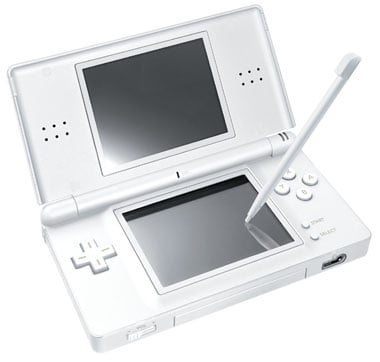
燃えろ!熱血リズム魂 おす!闘え!応援団2 (Burn! Hot-blooded rhythm soul Go! Fight! Cheerleaders 2) or Ouendan 2 as it is more practically known, is an epoch making revolution, disguised as a light-hearted rhythm game. You may ask ‘What is so revolutionary about a rhythm game?’ and the answer is that the gameplay alone may not be revolutionary, but this game is more than the sum of its parts. What is special about the gameplay, is that it will make you feel as if the DS was made specifically so Ouendan could come into existence. The interface is so intuitive and immediate that any game that expected you to do something as dull as memorize the buttons on the Playstation controller, now seems more than a little offensive. Here where you hit beats, run along slides and scrabble around spinning wheels as you see them, there is nothing between you and the actual ‘playing’ of the game. There is no need to worry hard-core pwnerers, this game gets very hard. And you can not call yourself a man until you have ‘done’ the cheerleader girls. Literally.
Of course, no one has made an action film about dancing your way to victory (that I know of, but I would seriously love to be corrected on this one), so Ouendan is free from those stylistic hangovers that haunt games so unforgivingingly. This game also frees itself from the ‘kookiness’ of rhythm games like Parappa the Rapper, and the pure plot evasion of DDR, Taiko games, and just about everything else on the rhythm game market. No, Ouendan is a proper story game.
Ouen is the Japanese word for ‘cheer’ as in ‘to cheer someone on’, and the Ouendan of the title are two groups of young hard-as-nails men, who wear uniforms redolent of those preferred by extreme right-wing political parties and gangsters in Japan. What do these suspicious young men do with their time? Car-jack and transport drugs? No. Embark on cop killing crusades, doomed to end in a bitter-sweet blood-spattered last stand when the swat hit the scene? No.
They solve ordinary Japanese people’s oppressively ordinary problems by dancing to J-pop.
In an obvious sideswipe at the current state of computer games, these violent, dangerous looking men take part in the campest of action to solve the smallest of problems. At first, the extreme ordinariness of the stories may seem silly; ‘I have to help a high school girl organise a choir club? Why?’, but as your hyperbole and cliché frazzled brain slowly accustoms to the game, you will care about and believe in these characters more than 500 hundred identikit fantasy worlds on the brink of destruction.
Continuing the theme of breaking the stale computer game blueprint, these stories are all exemplary pieces of moral correctness. Objectively. With every level, your heart will weep tears of joy (well, tears of blood, probably, but Joyful ones.) to have finally found a game that lets you do right again and again. The Ouendan use their cheer-leading skills only for good, bringing nothing but happiness. And as wanky as that sounds, it feels really good. Help a Sumo wrestler win matches so that his sponsorship money can support an orphanage? YES! Protect
Obviously, some of the stories do slip into the supermundane, but they do it with a style and charm that I have not witnessed in computer games in years. People may argue that the connection between music and story is spurious, but when is the last time that you solved anything by picking up some heavy weaponry and murdering armies of evil people with bad AI? That is right, never. And how many times have you been cheered on by great songs at times of trouble? Probably a few more times. The music is absolutely spot-on throughout the game, and from what I have seen of the track list for the Western conversion, Elite Beat Agents, it kicks the SHIT out of our attempt.
This game has broken games down, and built them up again from the beginning. Instead of dropping you in a clichéd world that you have to save despite not really loving, this game instead concentrates on showing you how to love the world. And once you have cheered these believable people on through their very human hopes and dreams, if the world were to come under threat, it would be something you would feel a real passion for fighting to save...
When Edge gave this game eight out of ten, at first I accepted that, as a very high score for Edge. But to be honest, I was wrong. a critic can not simply decide the value of a game, he must observe themes that it is trying to express, and the success with which it achieves its goals. Ouendan 2 is a ten out of ten game. We should not accept Edge’s scoring scheme, whereby the maximum possible score is eight out of ten, unless it is a Zelda game, which will get nine out of ten irrespective of whether it is any good or not. Edge holds on to that number ten for some mythical game-to-end-all-games. Well, Ouendan is the opposite. It is a new beginning for games. Developers take note, and don’t fucking waste it.

Ps. Once more, you can download the soundtrack to Ouendan 2 here
Wednesday, 25 July 2007
I gotta believe!!!
 I'm no PSP lover, but this shouldn't be missed. To celebrate the psp release of Parappa the Rapper, a certain 'psp fanboy' blog that I won't link to has provided eight tracks from the soundtrack for download. They're not songs that I would recognise, becuase I can't play the new game until they release it on a proper console. However, Parappa tunes are always choice, so here they are.
Pokemon
I have said before that I do not really feel qualified to talk about the new Pokemon games, as I have not really played deep enough into my copy of diamond to warrant it, and even if I had, my experience of the series as a whole is next to nonexistent. Oh happy chance it is then, that I have friends better qualified than I. I will shut up, and let Max do the talking.
Pokemon - the thinking man's chess
Pokemon is one of the best game franchises in the world. It is. No, it IS.
I am very, very good at the Pokemon games, partially because they directly reward obssessive behaviour. The more you battle your Pokemon, the higher their levels, the more opposing Pokemon Trainers you can gleefully trash. But there's more to Pokemon than cutesy animations and hour upon hour of ceaseless battle.
Pokemon's great strength lies in the fact that it is more multi-faceted a game than any other out there - there are just so many ways to play it. Of course there's the narrative to play through, which combines compelling characters with increasingly apocalyptic plots. In Pokemon Red, Blue and Yellow you were battling bring down a criminal organisation called Team Rocket. In Gold, Silver and Crystal, Team Rocket regrouped and set about kidnapping and dissecting and selling parts of Pokemon. In Ruby, Sapphire and Emerald you had to stop Team Magma and Team Aqua from destroying the world. In Diamond and Pearl you are battling to stop Team Galaxy from destroying the space-time continuum. For a supposed "children's game", it's all pretty heavy stuff.
There are also Pokemon Contests, in which your Pokemon has to perform to a crowd and appeal to a panel of in-game judges in one of five categories: cool, beauty, cute, tough or smart. These are a science in themselves, and there are players who take enough pleasure out of them to spend most of their time in the game competing against each other and the in-game opponents. Then there are gamers that spend most of their time breeding, in which you can exercise unprecedented control over a Pokemon's stats, natures and move-set and provide such an edge that no serious battler would dream of competitively using a Pokemon they hadn't hatched themselves.
Increasingly, games are filled to splitting with different modes and unlockable treats, but invariably these are just add-ons - they're not woven into the fabric of the game-world. All the aspects of Pokemon I've mentioned are not different modes with the same game mechanics and ideas behind them, they are literally different ways to experience the world of Pokemon, and each has an effect on the others. As the graphical capabilities of the consoles increase, sports sims and racing games are touted as being more "immersive" than anything seen before, and yet Nintendo have managed to create a game that is more genuinely immersive than any of those in Pokemon. And they've done that by creating a believable world. The concept of Pocket Monsters that fight each other may be ludicrous, but if you take their existence as assumed then the world that they would inhabit would almost certainly be the one depicted in the games. For example, the beginning of Pokemon Ruby/Sapphire/Emerald saw your character moving house, and the moving company consisted mainly of Machokes to move the large, heavy furniture around. Thinking about it, it's obvious that it would - if they existed then that's one of the things they'd be doing. People need help moving their furniture. The creators of Pokemon seem to have considered the impact that the existence of Pokemon would have on every aspect of life and the world, from transport (where you can fly on bird Pokemon or surf on water Pokemon) to electricity grids (powered by Voltorbs), from lighthouses (each with it's own Ampharos) to cooking (over heat generated by Slugmas). They've not been afraid to depict the mundane or practical applications of Pokemon, and that completeness is what makes the world of Pokemon so immersive and so compelling.
Pokemon is seen as a children's game, even by some of my closest friends, but that's because they are RISIBLE FOOLS who don't take the time to properly look at a game, or dismiss them just because they have cartoon monsters. If you think that different elemental types being super effective against others is the extent of battling, and that chatting to sparingly animated Pokemon Professors is the extent of character interaction, and that Pokemon Contests can be written of as pandering to Japanese fangirls because they have a competition catagory labelled "Cute", then that doesn't mean that Pokemon is a child's game, it means that you are a child.
Superficially, the demographic that Pokemon is aimed at are children, but to say that it's a "child's game" is derisive and patronising and implies that adolescents or adults can't enjoy or learn from it. There are parts of Pokemon that are quite clearly not aimed at children. For instance, there are moments of clear innuendo in the dialogue at the Veilstone Massage Parlour in Pokemon D/P, the beach in Pokemon R/S/E, and the Viridian Forest in G/S/C. How many children will laugh any of those? Of course, it's the fact that these borderline explicit pieces of dialogue are found in a game most would consider immature that makes it daring and unexpected and ultimately funny. Similarly, the battling mechanics. Most casual gamers get as far as the instruction manual's "fire beats grass, grass beats water, water beats fire" Pokemon battling "strategy". But beneath that is a very complex and even profound system. It's profound enough that the Pokemon community can battle over the Internet and in worldwide tournaments every day of every year for over a decade and still keep inventing new ways of structuring teams, and profound enough that 200 page booklets are being written just on potential movesets and tactics. My best friend and I have studied Pokemon Battling strategy for a long time now and we know a lot of stuff, a hell of a lot of stuff. A volume of stuff that would make many people out there seriously reconsider their friendship with us if they knew.
Over the many years and the four generations of Pokemon games I've clocked up over 500 hours of gameplay, and I'm proud to say that I still haven't seen it all and it's still fun enough to keep me up at night. How many of your "adult" driving games can do that?
Max the Felicitous
Pokemon - the thinking man's chess
Pokemon is one of the best game franchises in the world. It is. No, it IS.
I am very, very good at the Pokemon games, partially because they directly reward obssessive behaviour. The more you battle your Pokemon, the higher their levels, the more opposing Pokemon Trainers you can gleefully trash. But there's more to Pokemon than cutesy animations and hour upon hour of ceaseless battle.
Pokemon's great strength lies in the fact that it is more multi-faceted a game than any other out there - there are just so many ways to play it. Of course there's the narrative to play through, which combines compelling characters with increasingly apocalyptic plots. In Pokemon Red, Blue and Yellow you were battling bring down a criminal organisation called Team Rocket. In Gold, Silver and Crystal, Team Rocket regrouped and set about kidnapping and dissecting and selling parts of Pokemon. In Ruby, Sapphire and Emerald you had to stop Team Magma and Team Aqua from destroying the world. In Diamond and Pearl you are battling to stop Team Galaxy from destroying the space-time continuum. For a supposed "children's game", it's all pretty heavy stuff.
There are also Pokemon Contests, in which your Pokemon has to perform to a crowd and appeal to a panel of in-game judges in one of five categories: cool, beauty, cute, tough or smart. These are a science in themselves, and there are players who take enough pleasure out of them to spend most of their time in the game competing against each other and the in-game opponents. Then there are gamers that spend most of their time breeding, in which you can exercise unprecedented control over a Pokemon's stats, natures and move-set and provide such an edge that no serious battler would dream of competitively using a Pokemon they hadn't hatched themselves.
Increasingly, games are filled to splitting with different modes and unlockable treats, but invariably these are just add-ons - they're not woven into the fabric of the game-world. All the aspects of Pokemon I've mentioned are not different modes with the same game mechanics and ideas behind them, they are literally different ways to experience the world of Pokemon, and each has an effect on the others. As the graphical capabilities of the consoles increase, sports sims and racing games are touted as being more "immersive" than anything seen before, and yet Nintendo have managed to create a game that is more genuinely immersive than any of those in Pokemon. And they've done that by creating a believable world. The concept of Pocket Monsters that fight each other may be ludicrous, but if you take their existence as assumed then the world that they would inhabit would almost certainly be the one depicted in the games. For example, the beginning of Pokemon Ruby/Sapphire/Emerald saw your character moving house, and the moving company consisted mainly of Machokes to move the large, heavy furniture around. Thinking about it, it's obvious that it would - if they existed then that's one of the things they'd be doing. People need help moving their furniture. The creators of Pokemon seem to have considered the impact that the existence of Pokemon would have on every aspect of life and the world, from transport (where you can fly on bird Pokemon or surf on water Pokemon) to electricity grids (powered by Voltorbs), from lighthouses (each with it's own Ampharos) to cooking (over heat generated by Slugmas). They've not been afraid to depict the mundane or practical applications of Pokemon, and that completeness is what makes the world of Pokemon so immersive and so compelling.
Pokemon is seen as a children's game, even by some of my closest friends, but that's because they are RISIBLE FOOLS who don't take the time to properly look at a game, or dismiss them just because they have cartoon monsters. If you think that different elemental types being super effective against others is the extent of battling, and that chatting to sparingly animated Pokemon Professors is the extent of character interaction, and that Pokemon Contests can be written of as pandering to Japanese fangirls because they have a competition catagory labelled "Cute", then that doesn't mean that Pokemon is a child's game, it means that you are a child.
Superficially, the demographic that Pokemon is aimed at are children, but to say that it's a "child's game" is derisive and patronising and implies that adolescents or adults can't enjoy or learn from it. There are parts of Pokemon that are quite clearly not aimed at children. For instance, there are moments of clear innuendo in the dialogue at the Veilstone Massage Parlour in Pokemon D/P, the beach in Pokemon R/S/E, and the Viridian Forest in G/S/C. How many children will laugh any of those? Of course, it's the fact that these borderline explicit pieces of dialogue are found in a game most would consider immature that makes it daring and unexpected and ultimately funny. Similarly, the battling mechanics. Most casual gamers get as far as the instruction manual's "fire beats grass, grass beats water, water beats fire" Pokemon battling "strategy". But beneath that is a very complex and even profound system. It's profound enough that the Pokemon community can battle over the Internet and in worldwide tournaments every day of every year for over a decade and still keep inventing new ways of structuring teams, and profound enough that 200 page booklets are being written just on potential movesets and tactics. My best friend and I have studied Pokemon Battling strategy for a long time now and we know a lot of stuff, a hell of a lot of stuff. A volume of stuff that would make many people out there seriously reconsider their friendship with us if they knew.
Over the many years and the four generations of Pokemon games I've clocked up over 500 hours of gameplay, and I'm proud to say that I still haven't seen it all and it's still fun enough to keep me up at night. How many of your "adult" driving games can do that?
Max the Felicitous
Subscribe to:
Posts (Atom)